123
Band 1 · Elementary
Levels 1–3
The foundation: everyday characters, core vocabulary and basic sentences. By level 3 you know roughly 2,245 words and 900 characters. Gushi follows the official word lists here exactly.
Gushi turns every Chinese character into a tiny story you won't forget, then schedules your reviews with FSRS spaced repetition. The whole curriculum is aligned to the new nine-level HSK 3.0 standard — mock exams included.
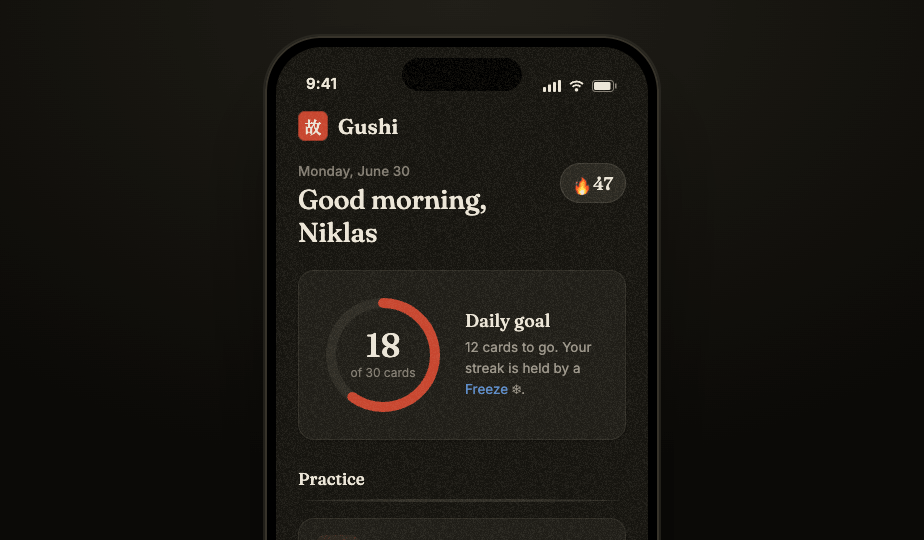
Gushi (故事, "story") is a premium, story-based app for learning to read Mandarin Chinese. Every character becomes a small mnemonic story, tones are colour-coded, words unlock only once you know their characters, and reviews are scheduled with FSRS spaced repetition. The entire curriculum is aligned to the new HSK 3.0 (2021) nine-level standard, with mock exams for every band. It's the deliberate opposite of gamified apps — calm, literary and built for real reading power.
The same explainer that opens the app. Two parts crash into a character, characters unlock words, and spaced repetition keeps every one of them alive.
A few a day. Each comes with a picture and a story — its parts, its meaning, and a hook for the sound.
A word is just characters together. Know its characters and it unlocks on its own — 你 + 好 = 你好.
Read real sentences built only from what you know, so grammar sinks in from examples, not rules.
You hear the words you can already read, so you know them by ear too — not just on the page.
Short graded texts unlock as you go — real Chinese made only of words you know, with a few checks.
女 woman + 子 child collide into 好 — good. You watch a character get built from its parts before anyone explains it.
No word before you know its characters. Everything you meet in Gushi, you can actually read — no frustrating walls of unknown text.
Each review lands right before you'd forget. It's the most efficient way known to grow a large vocabulary and keep it.
No streaks-shame, no cartoon mascots, no confetti. Just the features that actually build reading, listening and exam readiness.
A picture and a tiny story for every character, tying its parts to meaning and sound so it truly sticks.
The four tones plus neutral each get a fixed colour throughout the app — you never meet a word without its music.
Words appear only when you know their characters. Everything you see, you can read.
Each card returns right before you'd forget it. Grade your recall; the algorithm does the timing.
Hear the words you can read. Reading isn't enough for real speech — Gushi trains the ear in parallel.
Real Chinese texts made only of words you've learned, with quick comprehension questions.
Characters that draw themselves stroke by stroke, plus a tracing trainer for when you're ready to write.
Practice papers in the new HSK 3.0 format, so test day holds no surprises.
Start where you truly are. Claim only the levels you know and they go straight to review.
HSK 3.0 is the new standard for China's official Mandarin proficiency test. It's based on the 2021 grading standard (GF0025-2021); the updated exam syllabus was published in November 2025 and tests move to the new format through 2026. Here's exactly what changed — and how Gushi maps to it.
The foundation: everyday characters, core vocabulary and basic sentences. By level 3 you know roughly 2,245 words and 900 characters. Gushi follows the official word lists here exactly.
Real fluency territory: richer vocabulary, longer texts and the five skills in balance. By level 6, about 5,456 words and 1,800 characters — again matched to the official lists.
The advanced band, examined together: around 11,092 words and 3,000 characters, toward near-native reading. Gushi covers 7–9 split by word frequency for sensible pacing.
| Level | Band | Words (cumulative) | Characters |
|---|---|---|---|
| HSK 1 | Elementary | ≈ 500 | ≈ 300 |
| HSK 2 | Elementary | ≈ 1,272 | ≈ 600 |
| HSK 3 | Elementary | ≈ 2,245 | ≈ 900 |
| HSK 4 | Intermediate | ≈ 3,245 | — |
| HSK 5 | Intermediate | ≈ 4,316 | — |
| HSK 6 | Intermediate | ≈ 5,456 | ≈ 1,800 |
| HSK 7–9 | Advanced | ≈ 11,092 | ≈ 3,000 |
Where older HSK papers focused on listening and reading, HSK 3.0 formally assesses five skills. Your Gushi decks map straight onto them.
| HSK 2.0 (old) | HSK 3.0 (new) | |
|---|---|---|
| Levels | 6 levels | 9 levels in 3 bands |
| Bands | — | Elementary 1–3 · Intermediate 4–6 · Advanced 7–9 |
| Skills tested | Mainly listening & reading | Five: listening, speaking, reading, writing, translation |
| Top vocabulary | ≈ 5,000 words (HSK 6) | ≈ 11,092 words (levels 7–9) |
| Characters | ≈ 2,600 | ≈ 3,000 |
| Basis | 2009 syllabus | 2021 grading standard (GF0025-2021) |
| Rollout | Being phased out | Syllabus updated Nov 2025; tests moving over through 2026 |
Claim only the levels you truly know, so those characters skip ahead to review instead of wasting your time relearning them.
A few new characters a day, each as a small story that ties its parts to meaning and sound. Everything above is built from these.
FSRS surfaces what's due each day. Clearing it is the single habit that turns short-term memory into lasting recall.
Reading, listening and the rest advance together — a level completes only when characters, words and listening are all done.
Complete your target level's official word list, then take a mock exam in the new HSK 3.0 format so test day holds no surprises.
Vocabulary and character counts follow the official 2021 grading standard (GF0025-2021). Gushi follows the official HSK 3.0 word lists exactly for levels 1–6; levels 7–9 are split by word frequency for pacing. Figures are cumulative and rounded.
HSK 3.0 is the new standard for the HSK (Hanyu Shuiping Kaoshi), China's official Mandarin proficiency test. It's based on the 2021 Chinese Proficiency Grading Standards (GF0025-2021), which sort Chinese into nine levels across three bands — elementary (1–3), intermediate (4–6) and advanced (7–9). It replaces the older six-level HSK 2.0 and expands the vocabulary, character and grammar requirements. The updated exam syllabus was published in November 2025.
HSK 3.0 turns six levels into nine across three bands, roughly doubles the top-end vocabulary (about 5,000 words at old HSK 6 versus 11,092 at HSK 7–9), raises characters to around 3,000, and formally tests five skills — listening, speaking, reading, writing and translation — instead of mainly listening and reading. It also defines fixed lists of syllables, characters, words and grammar for each level.
Nine, grouped in three bands: elementary (levels 1, 2, 3), intermediate (levels 4, 5, 6) and advanced (levels 7–9, examined together as a single advanced band).
Five: 听 listening, 说 speaking, 读 reading, 写 writing and 译 translation. Lower levels lean on listening and reading; speaking, writing and translation grow more important at higher bands.
Cumulative, per the 2021 standard: Level 1 ≈ 500 words / 300 characters; Level 2 ≈ 1,272 words; Level 3 ≈ 2,245 words / 900 characters; Level 4 ≈ 3,245 words; Level 5 ≈ 4,316 words; Level 6 ≈ 5,456 words / 1,800 characters; Levels 7–9 ≈ 11,092 words / 3,000 characters.
Place yourself honestly at the level you know, learn the exact official word list for your target level, build all five skills rather than just reading, use spaced repetition so each word returns right before you'd forget it, and take mock exams in the new format before test day. Gushi is built around this exact workflow.
Gushi is designed specifically around the new HSK 3.0 standard: it teaches every character as a memorable story, colour-codes the tones, unlocks words only once you know their characters, schedules reviews with FSRS spaced repetition, and includes mock exams in the nine-level HSK 3.0 format. It follows the official word lists exactly for levels 1–6, is free to start, and runs on iPhone, Android and the web.
Yes — Gushi is free to start on iPhone, Android and the web. You can learn characters, unlock words, build listening and read graded articles at no cost.
Start free today and build real Chinese reading power — a few minutes a day, all the way to HSK 3.0 advanced.
加油 · jiāyóu — let's go